20 Low Maintenance Haircuts for Women That Save Time

A low maintenance cut works with your natural texture, not against it. Fine straight hair stays full with a blunt bob or a collarbone lob. Wavy or thick hair stays light with a choppy shag or hidden layers. Curls and coils stay calm with a dry cut or a protective style. Each cut below gives the exact words to use in the chair, plus a simple effort score, so you know the daily minutes, the trim gap, and how well it grows out.
A good cut should make mornings shorter, not longer. It should air dry into a shape you like, and it should still look fine when you miss a trim by a week or two. That is the test every cut below had to pass. Some cuts need almost no work at all. Others need a quick root lift or a light product, and the text says so plainly, so you do not pick a cut that needs more time than you have.
The cuts below cover fine, thick, wavy, curly, and coily hair. Each one says who it suits, how it stays low effort, and what to ask for. Short cuts run about 4 to 6 weeks between trims, and longer cuts run about 6 to 8 weeks. The one curtain-bang lob also carries a shorter fringe trim between full cuts, because a fringe loses its shape faster than the rest of the cut.
1. Classic Pixie Cut

A classic pixie keeps the length short all over, with a little more length on top to shape. It suits fine straight hair best, because short hair does not get weighed down, and it dries fast with almost no styling. It also suits women who want a bold, clean shape and do not mind a short cut. Ask for "a classic pixie, short at the sides and back, with a little length left on top to sweep." Wash it, add a pea-sized amount of light styling cream if you want, and let it air dry. Effort score: 2 minutes a day, trim every 4 to 6 weeks, grow-out very forgiving in the first weeks, then it needs a reshape.
2. Short Shag Haircut

A short shag uses short layers through the crown and around the face, so waves get lift instead of falling flat. It suits wavy hair best, and it suits thick hair that needs movement without a lot of bulk. The layers do the work, so you do not need to curl or tease the hair to get shape. Ask for "a short shag with choppy layers through the crown, blended into soft face-framing pieces." Scrunch a light wave spray into damp hair and let it air dry for a lived-in finish. Effort score: 3 minutes a day, trim every 4 to 6 weeks, grow-out forgiving.
3. Layered Bixie

A bixie sits between a pixie and a bob, with layered ends that keep it soft instead of sharp. It suits fine hair that lacks volume, because the layers add movement without taking away length at the ends. It also suits many face shapes, because the length can be set to the jaw or just below it. Ask for "a layered bixie, longer than a pixie, with soft layers through the ends and a side part." Dry it with your fingers for lift at the roots, then leave the ends alone. Effort score: 3 minutes a day, trim every 4 to 6 weeks, grow-out forgiving.
4. Blunt Chin-Length Bob

A blunt bob is cut straight across at the chin, with no layers to thin the ends out. It suits fine or thin hair best, because one level line makes the ends look thicker and hides signs of breakage. It suits straight hair and oval, round, and heart faces, and it frames the jaw in a clean way. Ask for "a blunt bob cut straight across at my chin, with no layers." Dry it smooth with a brush, or let it air dry for a softer line. Effort score: 3 minutes a day, trim every 4 to 6 weeks, grow-out moderate, because the blunt line softens as it grows.
5. Bold Buzzcut

A buzzcut keeps the hair very short all over, cut close with clippers. It suits any hair texture, because texture stops mattering at this length, and it suits women who want the shortest possible routine. It needs no drying, no brush work, and no styling product. Ask for "a buzzcut, kept even all over, at a length that still shows a little texture." Wash it and go, and keep the shape with a clipper trim at home or in the salon. Effort score: 0 minutes a day, trim every 3 weeks, grow-out moderate, because the shape changes fast as it grows.
6. French Bob

A French bob ends at the chin, with a soft fringe and an airy, undone finish. It suits straight and wavy hair, and it suits women who like a short cut with a little softness at the front. Once the fringe is trained to sit right, the cut needs very little work. Ask for "a French bob at my chin, with a soft fringe and airy, undone ends." Wash it, condition it, and let it air dry, with a quick finger sweep to set the fringe. Effort score: 3 minutes a day, trim every 4 to 6 weeks, grow-out forgiving.
7. Short Choppy Layers

Short choppy layers cut weight out of thick hair in short, uneven pieces, so the hair moves instead of sitting as one heavy block. It suits thick hair best, and it suits wavy hair that puffs up when it dries. The choppy ends keep the shape light, so the hair dries naturally without a long blow dry. Ask for "short choppy layers through my thick hair, to remove weight and add movement." Let it air dry with a light leave-in product, and shake the layers out with your fingers. Effort score: 3 minutes a day, trim every 4 to 6 weeks, grow-out very forgiving.
8. Ghost Layers

Ghost layers are hidden layers that start just above the shoulders, so they remove bulk from thick long hair without making it look shorter. It suits thick long hair best, because the outer length stays intact while the inside gets lighter. It also suits women who want long hair that dries faster and sits flatter at the roots. Ask for "ghost layers in my long thick hair, starting just above my shoulders, hidden under the top layer." Dry it as usual, and the hidden layers will keep the bulk down on their own. Effort score: 4 minutes a day, trim every 6 to 8 weeks, grow-out very forgiving.
9. Curly Mullet

A curly mullet keeps the front shorter and the back longer, hitting between the collarbone and the underarm. It suits thin curly hair, because the shorter front gives shape while the longer back keeps the length. The curl pattern gives the cut its movement, so no heat styling is needed. Ask for "a curly mullet, shorter at the front and longer at the back, cut to work with my curl pattern." Define the curls with a light curl cream or gel, and let them air dry. Effort score: 5 minutes a day, trim every 6 to 8 weeks, grow-out forgiving.
10. Classic Curly Cut

A classic curly cut is shaped on dry hair, curl by curl, so the length is judged on how the curls actually sit. It suits curly hair best, because wet cutting can leave curls shorter than planned once they spring up. It stops the puffy, triangle shape that comes from a cut that fights the curl pattern. Ask for "a classic curly cut, shaped dry on my natural curl pattern, with no thinning through the ends." Use a light curl product on damp hair, then let it air dry or diffuse on low heat. Effort score: 5 minutes a day, trim every 6 to 8 weeks, grow-out very forgiving.
11. 70s Shag Haircut

A 70s shag uses heavy layers and a feathered fringe to give wavy and curly hair body, shape, and movement. It suits wavy and curly hair best, and it suits thick hair that needs bulk taken out without losing shape. The layers keep the hair from sitting flat, so the cut looks styled even when it air dries. Ask for "a 70s shag with heavy layers and a feathered fringe, cut to suit my wave pattern." Scrunch a light product into damp hair and air dry for a soft, lived-in shape. Effort score: 4 minutes a day, trim every 6 to 8 weeks, grow-out forgiving.
12. Short Inverted Bob

A short inverted bob is shorter at the back and longer at the front, so the front pieces frame the face while the back stays light. It suits fine or thin short hair best, because the stacked back adds volume and body where fine hair often falls flat. It suits straight hair and women who want a bob with a little more shape than a blunt cut. Ask for "a short inverted bob, stacked at the back and longer at the front, to add volume." Dry the back with lift, and smooth the front pieces forward for a full outline. Effort score: 4 minutes a day, trim every 4 to 6 weeks, grow-out moderate, because the stacked back loses its lift as it grows.
13. Curly Side-Part Bob

A curly side-part bob keeps curls at bob length, with a side part that gives the hair a bouncy, full shape. It suits curly hair best, and it suits women who want a short curly cut that still has movement. The side part stops the curls from sitting in one flat shape, and it gives the front a natural sweep. Ask for "a curly bob with a side part, cut to keep my curls bouncy and full." Define the curls with a light product on damp hair, and let them air dry. Effort score: 5 minutes a day, trim every 6 to 8 weeks, grow-out forgiving.
14. Curly Undercut

A curly undercut shaves or cuts the back and sides very short, while the curls on top stay long and full. It suits curly hair best, and it suits women who want a bold shape with less hair to dry. The short sides cut drying time down, and the long top keeps the curls as the main feature. Ask for "a curly undercut, short at the back and sides, with my curls left long on top." Wash the top, add a light curl product, and air dry, with no work needed on the short sections. Effort score: 4 minutes a day, trim every 4 to 6 weeks for the undercut, grow-out moderate, because the short sections grow out fast.
15. Mid-Length U-Shape Cut

A mid-length U-shape cut is longer at the back than at the front, so the outline forms a soft U when seen from behind. It suits wavy hair best, and it suits medium lengths that need a shape without short layers. The shape keeps the ends full, so the cut does not thin out as it grows. Ask for "a mid-length U-shape cut, longer at the back and shorter at the front, with no short layers." Air dry it, or dry it smooth for a clean U outline. Effort score: 3 minutes a day, trim every 6 to 8 weeks, grow-out very forgiving.
16. Box Braids

Box braids are a protective style, not a scissor cut, but they belong here because they give coily hair a long break from daily styling. The hair is parted into small square sections, then braided down the length. It suits coily hair best, and it suits women who want a style that lasts for weeks with almost no daily work. Ask for "small square box braids, parted cleanly, at a length that suits my face." Keep the scalp clean, oil it lightly, and tie the braids up or down as you like. Effort score: 2 minutes a day, redo every 4 to 6 weeks, grow-out moderate, because new growth shows at the roots.
17. Twists

Twists are another protective style for coily hair, made by twisting two strands of hair together instead of braiding three. They suit coily hair best, and they suit women who want a softer, quicker install than braids. Twists keep the ends tucked away, so the hair stays protected while it rests. Ask for "two-strand twists, parted evenly, at a medium length." Keep the scalp clean and lightly oiled, and wear the twists loose or pinned up. Effort score: 2 minutes a day, redo every 4 to 6 weeks, grow-out moderate, because new growth shows at the roots.
18. Bantu Knots
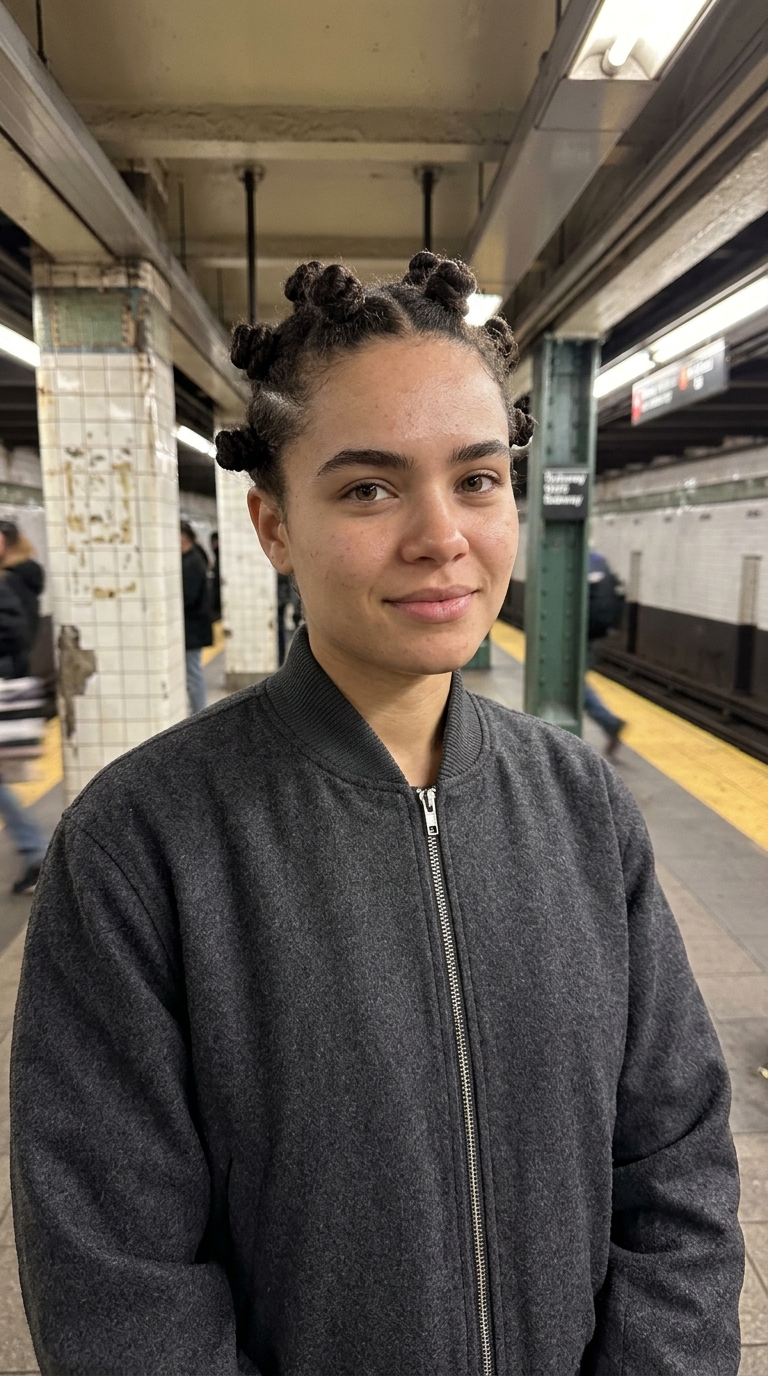
Bantu knots divide the hair into sections, then twist or coil each section into a small rounded knot on the head. They suit coily hair best, and they suit women who want a bold style that also sets a curl pattern when the knots come out. The knots protect the ends, and they need no heat at all. Ask for "Bantu knots, parted evenly, with small rounded knots that sit flat." Keep the scalp clean, and take the knots out gently if you want a defined curl set after. Effort score: 3 minutes a day, redo every 4 to 6 weeks, grow-out moderate, because new growth shows at the roots.
19. Curly Layered Haircut

A curly layered cut uses long rounded layers to balance curly and coily hair, so weight is spread evenly instead of sitting heavy at the ends. It suits curly and coily medium to thick hair best, and it suits women whose curls frizz when weight is left in one place. The rounded layers help control frizz and keep the shape full without a triangle outline. Ask for "long rounded layers in my curly hair, to spread the weight evenly and control frizz." Use a light curl product on damp hair, and air dry or diffuse on low heat. Effort score: 5 minutes a day, trim every 6 to 8 weeks, grow-out very forgiving.
20. Wavy Bob

A wavy bob keeps wavy hair at bob length, with light face-framing pieces that lift the natural wave. It suits wavy medium-density hair best, and it suits women who want a bob that air dries into a shape on its own. The wave gives the bob its body, so no curling tool is needed. Ask for "a wavy bob with light face-framing pieces, cut to work with my natural wave." Air dry it with a light wave spray, and the face-framing pieces will set the shape. Effort score: 3 minutes a day, trim every 6 to 8 weeks, grow-out forgiving.
The pattern across these cuts is simple. Fine hair needs a clean line or a short shape that keeps the ends full. Thick hair needs weight taken out, either with choppy layers or with hidden layers that do not show. Wavy hair needs layers that lift the wave instead of flattening it. Curly hair needs a dry cut that respects the curl pattern. Coily hair needs either a rounded layered cut or a protective style that rests the hair for weeks. Pick the group that matches your texture first, then pick the length you are happy to keep.
Heat is not needed for most of these cuts, but if you do use heat, keep it simple and safe. Use a blow dryer or a diffuser on damp hair only. Use a flat iron or a curling wand on hair that is fully dry only, never on damp hair. Keep the heat at about 150C or 300F for fine or bleached hair, and at 180C to 200C or 355F to 390F for coarse hair. Always use a heat protectant first, and let the hair cool before you touch it, so the shape sets.
Frequently Asked Questions
What is the most low maintenance haircut for women? A classic pixie or a blunt bob is the easiest to keep, because both air dry fast and need almost no styling. A pixie takes about 2 minutes a day, and a blunt bob takes about 3 minutes. If you want to keep length, ghost layers or a mid-length U-shape cut are the easiest long options, because they grow out well and need a trim only every 6 to 8 weeks.
How often should I trim a low maintenance cut? Short cuts need a trim every 4 to 6 weeks, and longer cuts need a trim every 6 to 8 weeks. A buzzcut is the one exception, because it needs a clipper trim about every 3 weeks to keep its shape. A curtain-bang lob also needs a fringe trim between full cuts, because a fringe loses its shape faster than the rest of the hair. Protective styles like braids, twists, and Bantu knots need a redo every 4 to 6 weeks, not a trim.
What are the best low maintenance cuts for thick or coily hair? For thick hair, ghost layers and short choppy layers work best, because they remove bulk without making the hair look shorter. For coily hair, a curly layered cut spreads weight evenly and controls frizz, and box braids, twists, and Bantu knots give the hair a long rest from daily styling. A classic curly cut, shaped on dry hair, also works well for curls and coils, because it judges length on how the curls actually sit.
Are low maintenance cuts always wash and go? No, not all of them. A buzzcut, a pixie, and a wavy bob are close to wash and go. A French bob needs the fringe trained to sit right, a curly cut needs a light product on damp hair, and a shag needs a quick scrunch to set the layers. The effort score on each cut tells you the truth, so pick a cut whose daily minutes fit your mornings, not just one that looks easy in a photo.
How do I pick a low maintenance cut for my face shape? Start with your hair texture, not your face shape, because texture decides how a cut will dry. Then set the length by your face: a bob or a bixie frames a round or square face well, a lob softens a long face, and a side-part bob gives a full shape to a narrow face. Tell your stylist both facts, your texture and your face shape, and use the exact Ask for words on the cut you pick, so the cut is set for your hair, not just for the photo.