20 Curtain Bangs for Thick Hair That Stay Light

Curtain bangs work on thick hair when the fringe is cut longer than you think, taken from a smaller section than you expect, and thinned at the ends instead of worn at full density. Cut heavy and blunt straight across thick hair, the same fringe puffs out at the sides and sits like a shelf. Kept long, feathered and blended into face framing layers, it sweeps open instead. It takes weight off the front of the cut, and it grows out without a hard line.
Thick hair changes the maths of a fringe. Fine hair needs extra hair pulled forward to look like anything at all. Thick hair brings too much. A standard triangle section cut at full thickness lands heavy, kicks out at the ends and separates in the middle by lunchtime. The fix is not avoiding bangs. Cut them longer so they blend. Soften the last inch so they lie flat. And let your stylist take the bulk out from inside the fringe rather than across the front of it.
The 20 versions below come from the curtain bang guides stylists publish for exactly this hair type. They run from a barely there wisp to a full bombshell sweep. Each one says where the longest pieces should land, who it suits, the exact words to use in the chair, and how often it needs trimming. On thick hair, the difference between a fringe that floats and one that fights you is almost always the section size and the last inch of the cut.
1. Cheekbone Sweep Curtain Bangs

This is the classic starting point. The fringe is centre parted, and its longest pieces graze your cheekbones and open your face up at its widest point. On thick hair this length is your safety margin. Anything shorter springs outwards under its own weight, while cheekbone length has the drop to lie flat and blend into the layers below. It suits round and heart shaped faces best, because the sweep draws the eye down and out. Ask for "curtain bangs that open at the cheekbone, cut long and feathered at the ends, with the weight taken out of the last inch." Book a fringe trim every 3 to 4 weeks. Once the longest pieces pass the cheekbone, the shape stops reading as bangs.
2. Classic Wispy Curtain Bangs
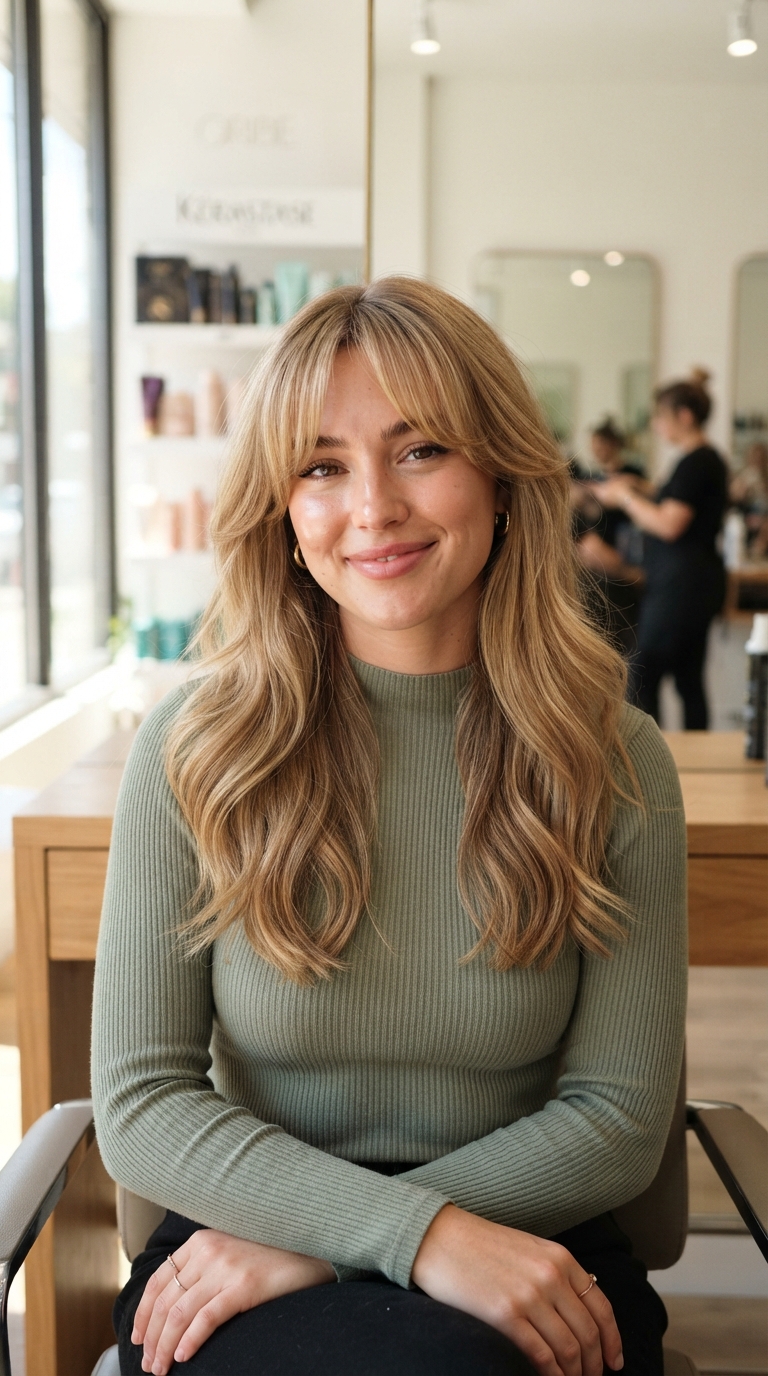
This is the Bardot style fringe, cut deliberately wispy so thick hair never has to wear its full density at the front. Your stylist takes a shallow section and point cuts the ends, or runs texturizing shears through them, so the fringe reads soft and see through at the edges rather than solid. It suits almost every face shape. It is also the lowest risk first fringe, because the wisps tuck behind your ears on bad days. Ask for "wispy curtain bangs from a small section, texturized through the ends so they never sit heavy." Trim every 4 to 6 weeks. The wispy ends forgive an extra week better than any blunt version.
3. Chin Length Curtain Bangs
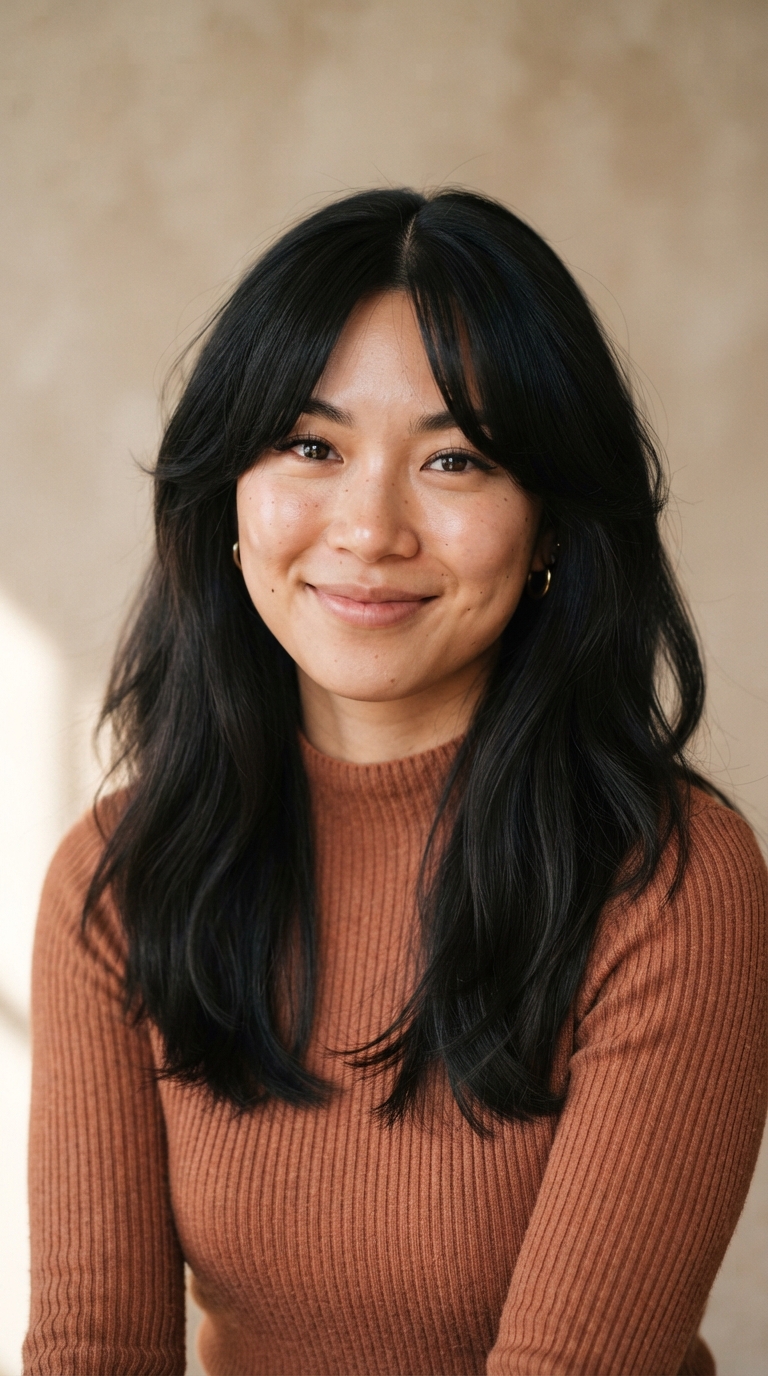
This is the longest curtain on the list. The shortest pieces sit at your lips and the longest fall to your chin, where the fringe stops being a fringe and becomes the first face framing layer. Thick hair carries this length beautifully. The weight that ruins short bangs pulls these straight and smooth. It suits long hair and anyone who is not ready to commit, because it pins back, tucks away and grows out without a visible line. Ask for "long curtain bangs that end at the chin and feather into my layers, no shorter pieces above the cheekbone." It needs the least upkeep here. A tidy every 6 to 8 weeks, with your normal cut, is enough.
4. Feathered Curtain Bangs

Feathering cuts the fringe into soft, flicked layers that graduate from your brow out to your jaw, so no single shelf of thickness ever forms. The ends are sliced rather than cut straight. That slicing is exactly what stops thick hair from puffing at the sides of your face. Paired with long layers behind it, this is the full volume upgrade that still moves when you walk. It suits oval and square faces and softens a strong jaw. Ask for "feathered curtain bangs, sliced at the ends and blended into long layers, nothing blunt anywhere." Trim every 6 weeks to keep the graduation clean.
5. Layered Curtain Bangs
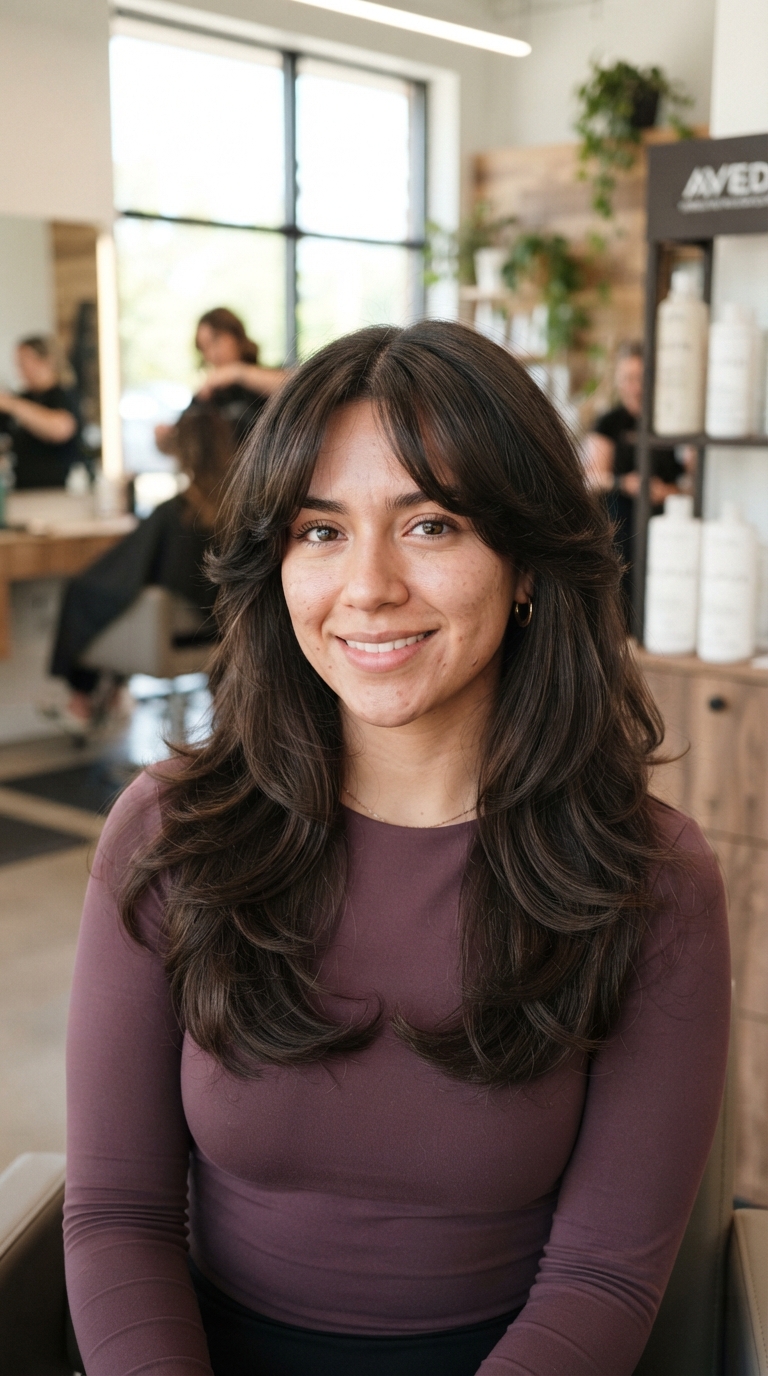
Here the fringe and the haircut share one system of layers. The bangs step down into face framing pieces, and those step down into the lengths, so thick hair sheds weight at every level instead of only at the bottom. Stylists call the effect ghost layering. The surface stays smooth while the inside of the hair carries the movement. It suits anyone whose thick hair goes triangular, wide at the ends and flat at the roots. Ask for "curtain bangs layered into the rest of the cut, with internal layers so the bulk comes out of the middle, not the surface." Trim every 6 to 8 weeks with the main cut.
6. Textured Curtain Bangs

This is the modern, piecey take. The fringe is cut with visible texture, uneven ends and separation, and a slightly undone finish that thick hair holds all day without help. Texture is the thick hair cheat code. Broken up ends cannot form the solid curtain that swings and separates as one lump. The cut suits straight to wavy hair, and anyone who styles with a flat iron and bends random pieces away from the face. Ask for "textured curtain bangs, point cut and piecey, with the heaviness broken up through the ends." Trim every 4 to 6 weeks. The shape is forgiving as it grows.
7. Micro Curtain Bangs

This is the shortest and boldest option. It is a baby curtain that sits above the brow to the upper lash line and parts in the middle like its longer sisters. On thick hair it only works cut fine and wispy, never at full density, or it reads as a solid block sitting on your forehead. It suits oval faces, strong brows and anyone after an edgier finish. It also creates the look of volume at the front without the weight. Ask for "micro curtain bangs, kept thin and texturized, shorter in the centre and opening fast at the sides." This is the highest maintenance cut here. A trim every 2 to 3 weeks keeps it micro.
8. Bouncy Curtain Bangs
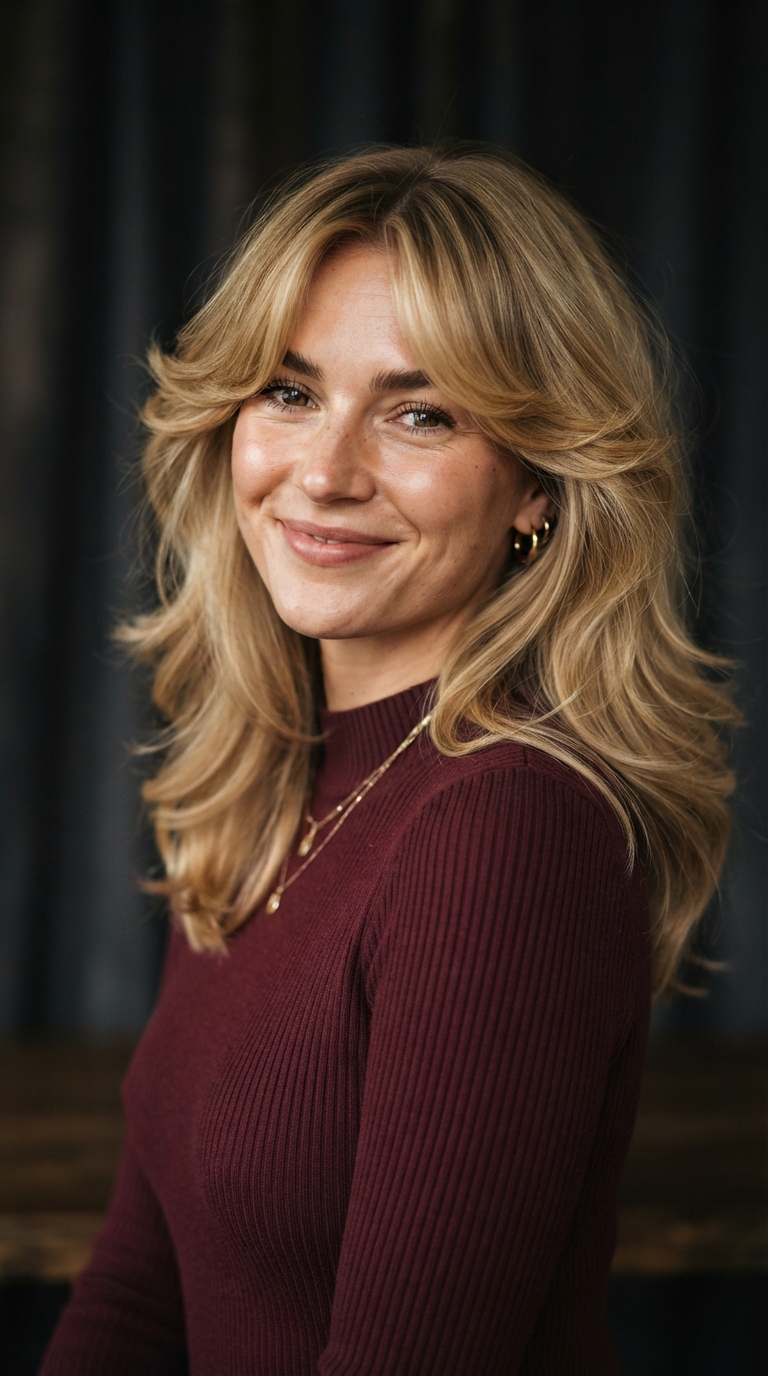
This is the blowout version. The fringe is full and rounded, dried with a round brush so it arcs away from your face in one smooth, bouncy sweep on each side. Thick hair is an advantage here because the fringe has the body to hold the curve instead of collapsing flat by midday. It suits anyone who blow dries anyway and wants the polished salon finish every day. Ask for "curtain bangs cut to sit just above the cheekbone, with enough length to wrap around a round brush, and the ends softened so they bend instead of kick." Trim every 4 weeks. For the longest lasting bounce, set each side in a velcro roller while it cools.
9. Voluminous Curtain Bangs

This is a fuller, glamorous curtain with real height at the root and a wide sweep, built for hair that has plenty of depth and layers to support it. The trick on thick hair is where the volume sits. Lift it at the root and through the curve, but thin the last inch so the ends still flick rather than hang. It suits long hair worn in waves, and anyone who finds wispy fringes disappear against their density. Ask for "full curtain bangs with volume at the root, but keep the ends light, I do not want them heavy." Trim every 4 to 6 weeks. Root lift is a styling job, so rough dry the fringe forward first, then sweep it back.
10. Full Coverage Curtain Bangs

This is the densest curtain that still counts as one. A wide section is worn with a middle part or draped across the forehead, giving you the full fringe effect with a soft centre opening. It is the version people fear on thick hair. It works only when your stylist thins the inside of the fringe and is willing to take more out at your next visit if it still feels heavy. Stylists recommend exactly that approach. It suits larger foreheads and anyone who wants a real transformation rather than a hint. Ask for "full curtain bangs, but thin the inside of the fringe so it lies flat, and leave them long enough to sweep." Trim every 3 to 4 weeks. Density shows growth the fastest.
11. Eye-Grazing Curtain Bangs

This is the sultry middle length. The shortest pieces skim your eyes and lashes before opening out to your cheekbones. On thick hair the danger is weight sitting in your eyes all day, so the centre is cut slightly thinner than the sides, and the whole fringe is kept just long enough to sweep aside. It suits anyone who likes a little drama and does not mind touching their fringe, because this length lives in your sightline. Ask for "eye grazing curtain bangs, finer in the middle, and show me how to sweep them so they stay open." Trim every 3 weeks. A week too long and you will be pushing them aside every hour.
12. Side-Swept Curtain Bangs

This curtain is cut to be worn pushed to one side, so both halves sweep across your forehead in one direction instead of opening in the middle. It is the natural answer for a strong cowlick at the front hairline, because the fringe works with your growth direction instead of fighting it every morning. On thick and curly hair it also keeps the curtain shape on days when a centre part will not sit. Ask for "curtain bangs I can wear side swept, longer on the heavy side, texturized so they cross over without bulk." Trim every 4 to 6 weeks.
13. Curly Curtain Bangs
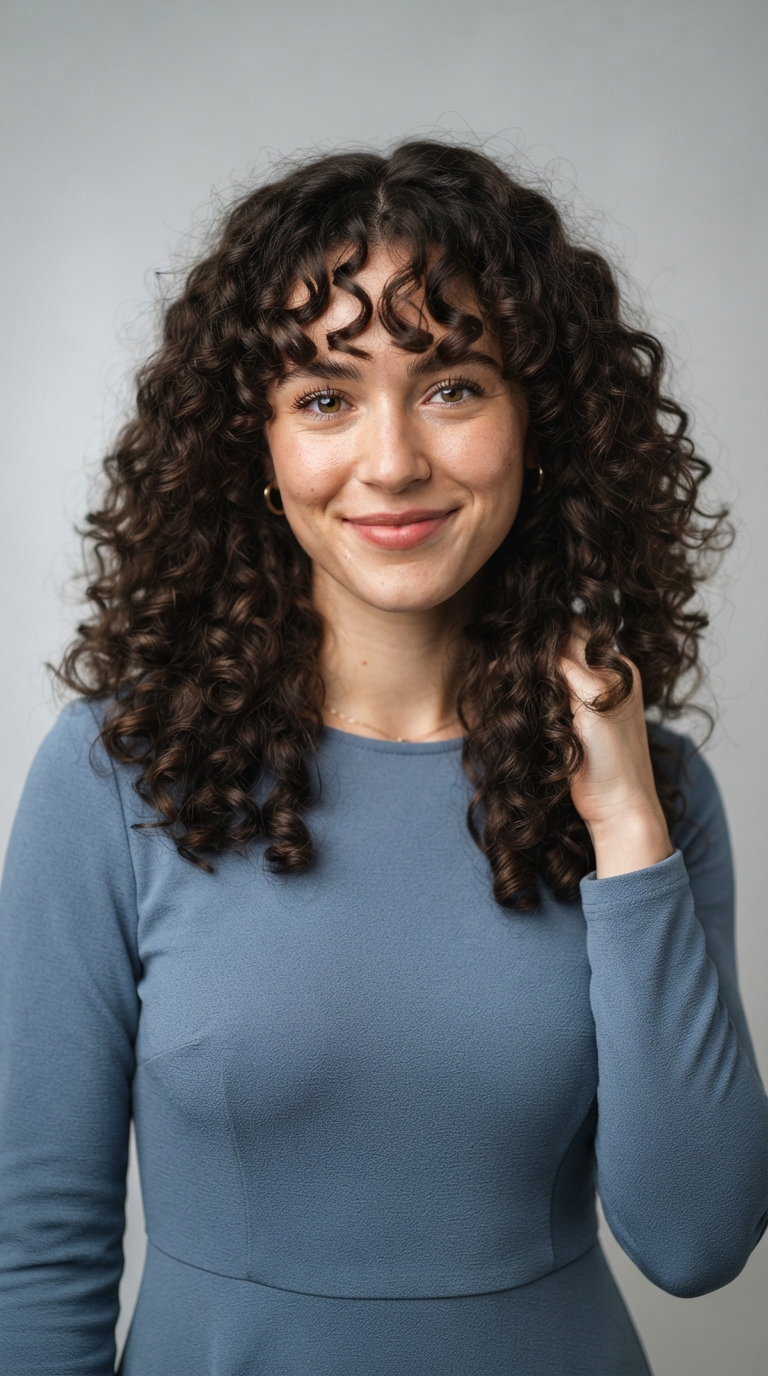
This one is proof that thick, curly hair can wear the trend. The curtain is fuller and cut dry, curl by curl, at a length that looks long in the chair because it will spring up once it dries. Every stylist who cuts curly fringes repeats the same rules. Arrive with your natural texture in. Never let the fringe be cut wet and stretched. And expect a fuller shape rather than the sweeping seventies flick, which very curly hair rarely holds. Ask for "curtain bangs cut dry at their natural curl, left longer than we think, and shaped so the curls frame my cheekbones." Trim every 6 to 8 weeks, since curl hides growth well.
14. Shaggy Curtain Bangs

This is the fringe half of a shag. Choppy, layered, deliberately messy curtains, paired with a shag or a heavily layered cut behind them. Thick hair and shags belong together because the cut removes weight everywhere at once. The fringe is razored or point cut, so its edges wisp and kick instead of forming a block. It suits wavy hair and anyone who air dries and wants the fringe to look better undone than done. Ask for "shaggy curtain bangs with choppy, broken up ends that match the layers in the back." Trim every 6 weeks. The mess hides a late appointment better than any polished version.
15. Curtain Bangs with a Bob

A bob plus curtains is the combination that saves thick hair from the dreaded triangle. The fringe breaks up the front, while the bob's ends are texturized so the shape stays narrow at your jaw. The styling detail that makes it work is direction. The ends of your bangs should curl under and out the same way the bob's ends do, so the whole cut reads as one shape. It suits chin to shoulder length hair and round or square faces. Ask for "curtain bangs with my bob, and thin the ends of the bob so it does not flare." Trim both every 6 weeks to hold the line.
16. Curtain Bang Pixie

This is the short answer. A pixie crop with a longer, parted fringe left on top, sweeping open at the front while the back and sides are cropped close. For thick hair it is a genuine weight removal strategy, because most of the density leaves with the cut, and what remains is styled forward with a little pomade. It suits petite features, strong cheekbones and anyone ready for a real change. Ask for "a pixie with a longer curtain fringe on top, texturized so the thickness does not sit on my forehead." Pixies need the salon most. A tidy every 4 to 6 weeks keeps the shape from growing into a helmet.
17. Old Hollywood Curtain Bangs

This is the glamorous throwback. Long, flicked out curtains with a smooth, waved finish, in the line of the seventies screen look that stylists still reference by name. Thick hair gives this style its drama. The flick needs density to read as a wave rather than a wisp, and thick hair holds the shape from a set far longer than fine hair does. It suits longer hair worn in loose waves, and anyone dressing up a simple cut for evenings. Ask for "long curtain bangs I can flick out with a round brush, cut to open at the cheekbone and blend into waves." Trim every 6 weeks. The length is forgiving.
18. Eighties Curtain Bangs

This is the retro rock version. A flippy, feathered front fringe with a pseudo mullet attitude, worn air dried with texture spray and plenty of movement. It leans into everything thick hair does naturally, body, kick and a slightly unruly finish, so the styling takes minutes rather than a full blowout. It suits anyone whose cut already has short layers or a shag behind it. Ask for "eighties style curtain bangs, feathered and flippy, cut to air dry with texture and not sit flat." Trim every 6 weeks. On day two, refresh the flip with dry texture spray rather than heat.
19. Piecey Curtain Bangs

This fringe is cut and styled in separated pieces, with deliberate gaps that let your forehead show through in places. Pieceiness is a precision thinning job. Your stylist carves small channels into the fringe so it falls in strands instead of a sheet. It is the single most effective fix when thick bangs keep rejoining into one heavy curtain. It suits fine featured faces under a lot of hair, and anyone who found full coverage too much. Ask for "piecey curtain bangs, carved into separated pieces so they never sit as one solid fringe." Trim every 4 weeks to keep the separation carved in.
20. Long Face-Framing Curtain Bangs
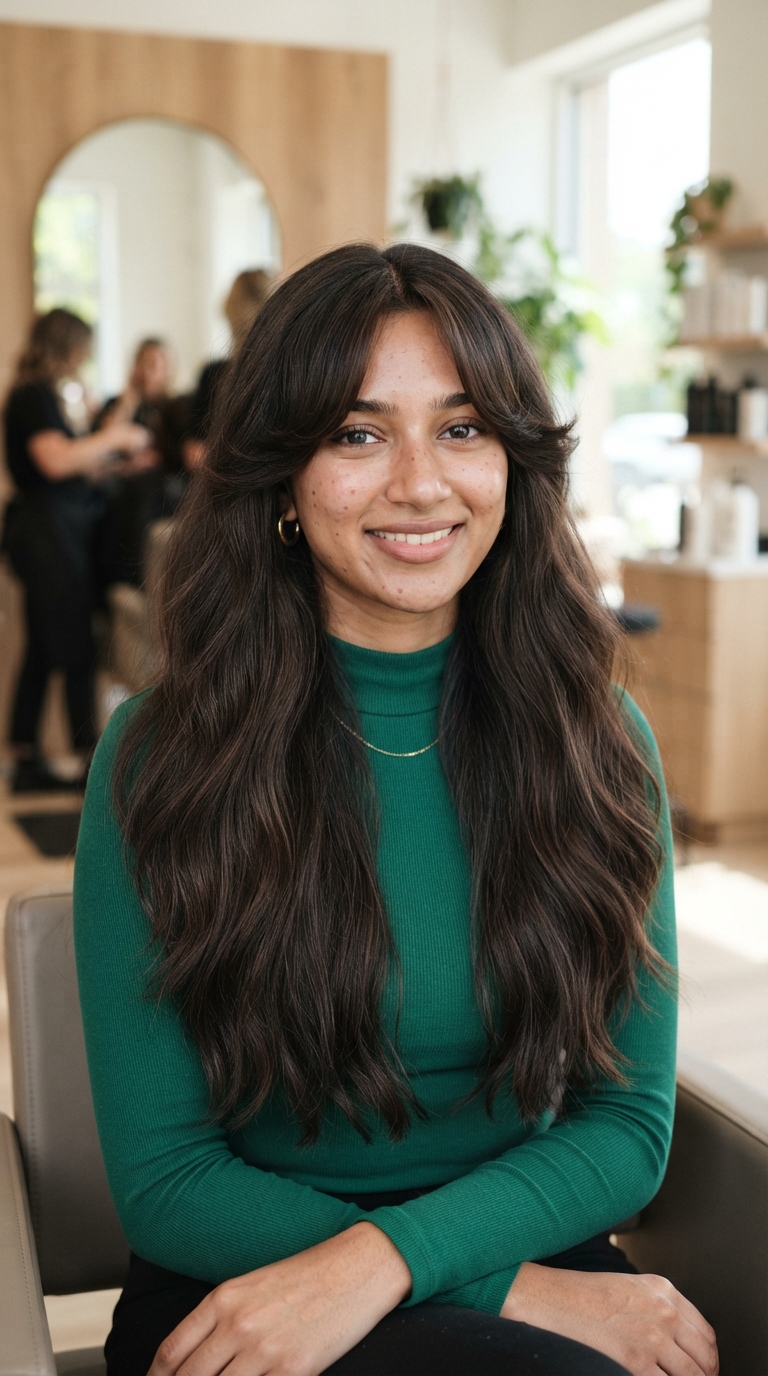
This is the version stylists reach for first on thick hair. The curtains are longer and are really the first of the face framing layers, hitting at the cheekbone or lower, and sometimes they are the only layer cut around the face. Because they start lower, they add shape and definition to extra long hair, so the lengths stop weighing your face down. The fringe itself never carries enough density to puff. It suits long, one length hair and anyone growing out a shorter fringe. Ask for "long curtain bangs that blend straight into face framing layers, the first layer starting at my cheekbone." Trim every 6 to 8 weeks with the layers.
Read across all 20 and one pattern repeats. On thick hair, curtain bangs succeed or fail in the section and the ends. A smaller triangle, a longer starting length, and weight removed from inside the fringe give you the sweep in every photograph. A wide section cut short and blunt gives you the shelf, the puff and the fringe that separates by lunch. Choose the version that matches how you actually style your hair, not the one that needs a daily blowout you will never do.
One styling note covers nearly all of them. Dry the fringe first, before the rest of your hair, because thick bangs that air dry in the wrong direction rarely recover. Blow them straight down with a flat brush. Then use a round brush held vertically to flick each side up and out, away from your face, and let them cool before you touch them. Dry shampoo is the fringe's best friend between washes. Thick bangs absorb forehead oil, sweat and skincare faster than the rest of your head, and a mist at the roots at night means they wake up separated and ready instead of stuck together.
Frequently Asked Questions
Do curtain bangs work on thick hair?
Yes. Stylists count thick hair as a good candidate, as long as the fringe is adapted. The three adaptations are simple. Take a smaller section than standard. Start longer, so the fringe blends into face framing pieces instead of sitting on your forehead. And texturize through the ends, so the weight comes out of the last inch. Cut that way, thick hair actually holds the curtain shape and the flicked out finish longer than fine hair does, because there is enough body to keep the curve.
How do I stop thick curtain bangs puffing out at the sides?
Puffing is a cutting problem before it is a styling one. It happens when the section is too wide or the ends are cut blunt, so the full density of the hair kicks outward. The fix in the chair is point cutting or texturizing shears through the ends and removing weight from inside the fringe. At home, dry the bangs straight down first, then flick them out with a round brush; drying them sideways while they are wet sets the kick in. If a set of bangs still puffs, a stylist can thin them at a quick fringe appointment rather than recutting them.
How often do curtain bangs need trimming?
It depends on the length you chose. Short and micro versions need a tidy every 2 to 3 weeks to stay short, standard cheekbone curtains sit happily at 3 to 4 weeks, and the long, layered versions can run 6 to 8 weeks alongside your normal haircut. Bangs appear to grow faster than the rest of the hair because a few millimetres at the front changes the whole shape. Many salons offer quick, cheap fringe trims between cuts, and that ten minute appointment is what keeps a curtain looking deliberate.
What should I ask my stylist for so they do not end up too heavy?
Say the three things that matter. Keep the fringe longer than the final look so it can blend. Take the weight out of the ends and the inside of the fringe rather than cutting more hair into it. And start with a smaller section, because more hair can always be added at the next visit, and it cannot be taken back once cut. Bring a photograph of the exact length point you want. Cheekbone, eye grazing and chin mean very different cuts. If the fringe still feels heavy afterwards, thinning is a normal adjustment, not a failed haircut.
Who should avoid curtain bangs?
Two honest exceptions come up in every stylist guide. A strong, uncontrollable cowlick right at the front hairline will fight a centre parted fringe daily. A side swept version often works there, because it follows the growth direction. A very small or short forehead can also be overwhelmed by bangs, making your face look smaller. A longer, wispier curtain starting lower is the workaround. Everyone else, including curly and coarse textures, has a workable version, cut dry and longer than instinct suggests.